

Dr. Tse Yin Nga Kelly
LIT4060 Literature and the Environment
As part of the Collaborative Online International Learning (COIL) initiative at The Education University of Hong Kong (EdUHK), LIT4060 Literature and the Environment integrated an online guest lecture on climate change representations in literature and culture, delivered by Dr. C. S. Bhagya (National Law School of India University, India) via Zoom on 26 March 2026. This COIL activity was designed to embed international perspectives into course delivery and to foster students’ critical awareness of climate change representations across diverse cultural contexts. The lecture explored climate fiction, documentary forms such as Shaunak Sen’s All That Breathes, and Rob Nixon’s concept of “slow violence,” while also introducing Sarah Nuttall’s call for a sustained practice of rereading. Following the lecture, students engaged in a discussion on the challenges of teaching climate change. The materials below serve as an exemplar of how COIL can be implemented at course level to enrich undergraduate learning experiences.
Guest Lecture on Climate Change Representations in Literature and Culture
Dr. C. S. Bhagya’s lecture explored how literature and media represent climate change. She began with various literary representations, focusing on climate fiction (cli-fi) which not only imagines climate change as apocalypses but also challenges established assumptions and opens up alternative ways of thinking about the future. While cli-fi often highlights the present and future risks of ecological breakdown in ways that journalism cannot, much of it has been written from developed‑world perspectives and is thus limited in terms of its sociological imagination. To address this gap, she pointed to writers such as N. K. Jemisin and Nnedi Okorafor and suggested a larger and growing corpus of “‘Afrodiasporic, African, indigenous and aboriginal speculative fiction’ (Mackey 531) that reimagines the future from the margins of modernity”.
Moving on, Dr. Bhagya examined how documentary forms can represent climate change as a continuous, planetary process with unscalable temporal and spatial scales. She used Shaunak Sen’s All That Breathes (2022) as an example to show how such forms evoke Rob Nixon’s concept of “slow violence”, a kind of violence that unfolds gradually, accumulates over time, and is unevenly distributed across places and communities, often without being recognized as violence at all.
Finally, Dr. Bhagya drew on Sarah Nuttall’s discussion of planetary literature and argued for “a sustained practice of rereading” that treats environment and climate in earlier texts as “agentive nonhuman form”. She illustrated this approach by close reading the river imagery in Arundhati Roy’s The God of Small Things. The lecture concluded with a discussion led by Dr. Kelly Tse about the challenges of representing and teaching climate change, and about which media forms and genres might be most suitable. During the discussion, Dr. Bhagya shared her comic work The Great Bangalore Road Show, which highlights the danger of normalizing urban precarity and environmental degradation in contemporary Bangalore.
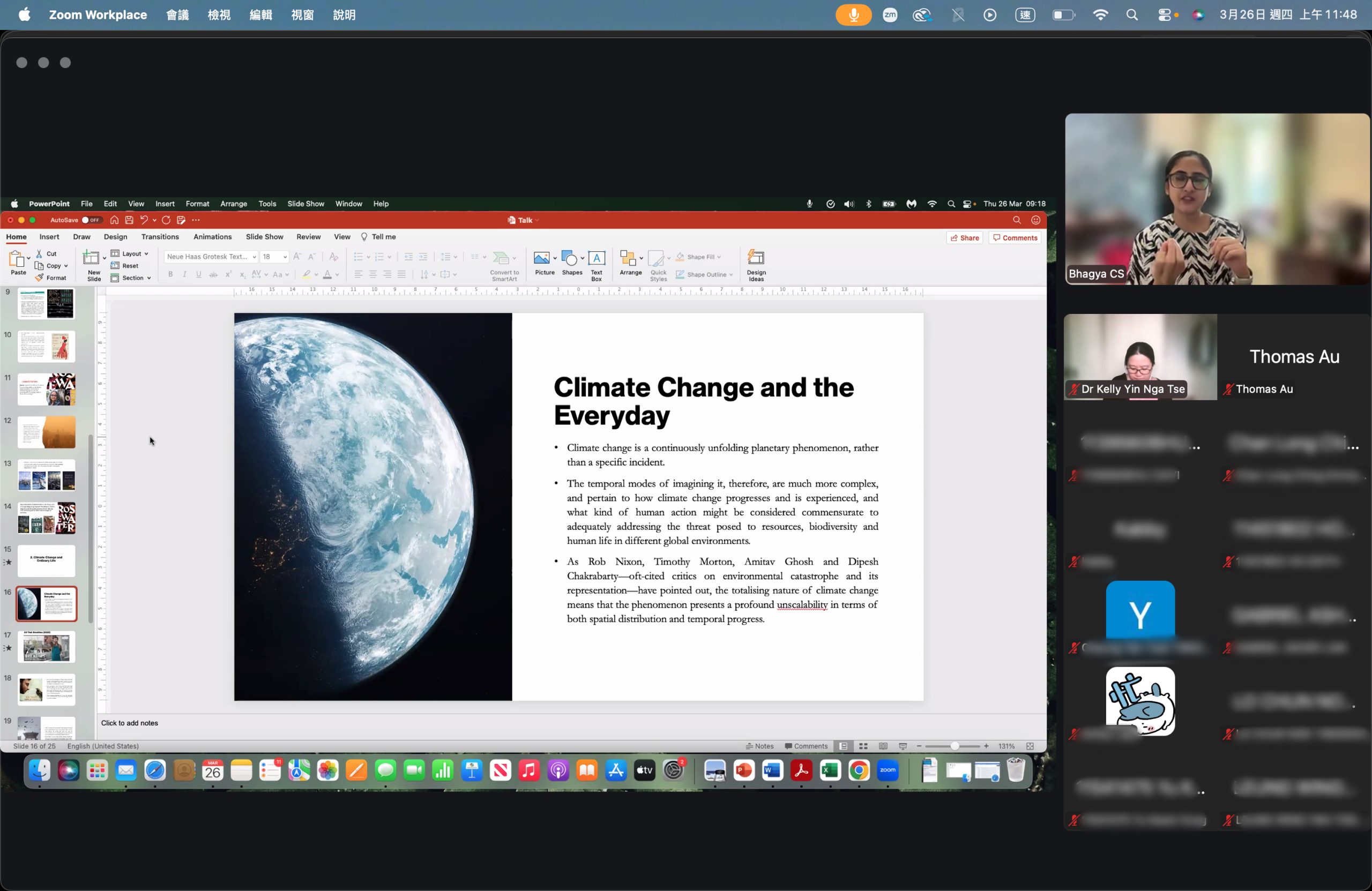
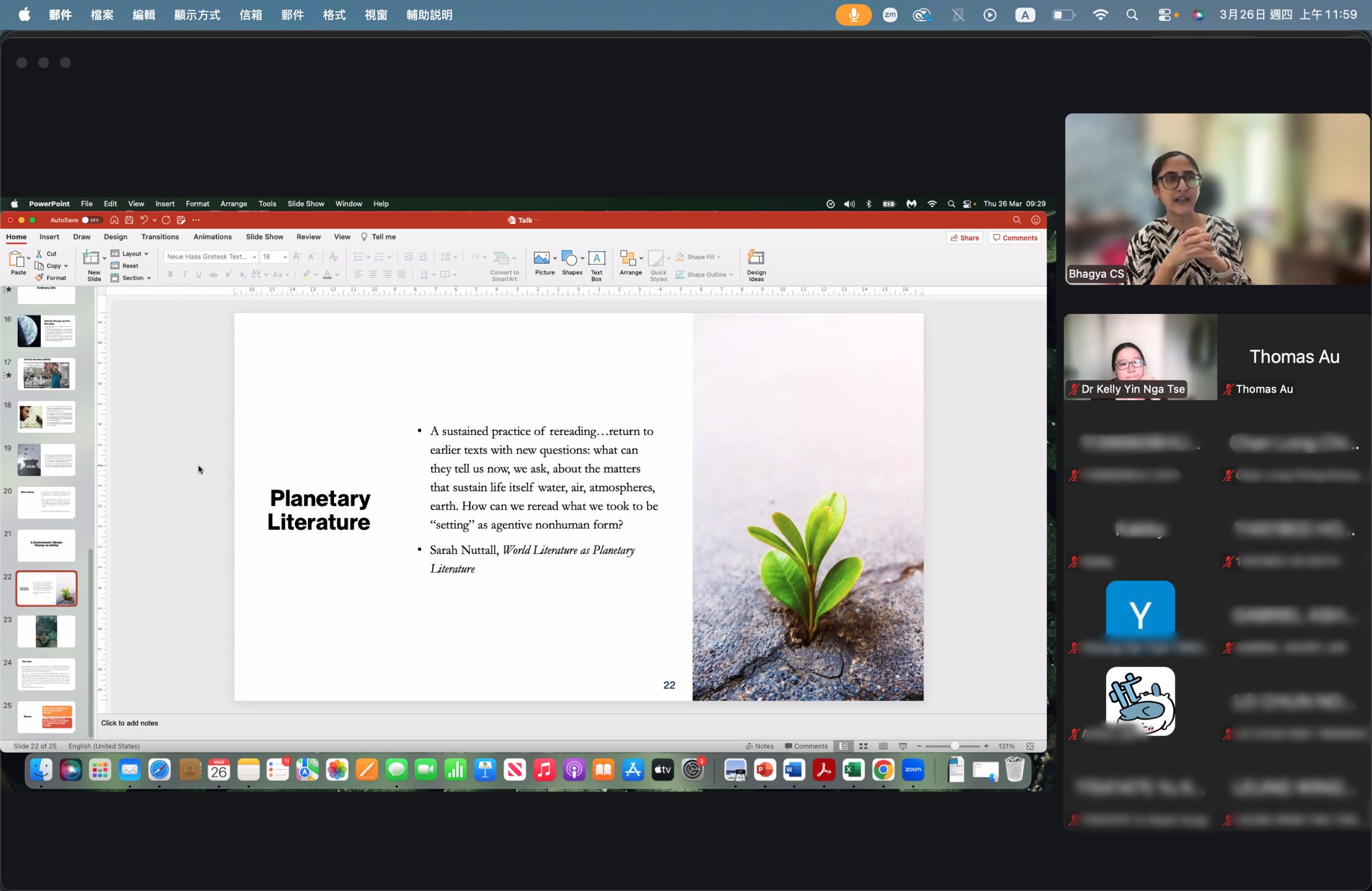
(guest lecture on Zoom)