
Dr. Lam Sin Manw Sophia
CHI6499 Second Language Acquisition and Chinese Language Learning
As part of the Collaborative Online International Learning (COIL) initiative at The Education University of Hong Kong (EdUHK), CHI6499 Second Language Acquisition and Chinese Language Learning integrated a semester-long collaborative project with MA students and school learners from institutions in the United Kingdom, Italy, and Hong Kong from January to February 2026. This COIL activity was designed to foster intercultural understanding and translanguaging practices through creative, artefact-based collaboration across university and school contexts. Following a live hybrid lecture on the conceptualisation of culture, students engaged in weekly thematic explorations—friendship, nature, and space—developing translanguaging artefacts such as multilingual poems and visual compositions. The materials below serve as an exemplar of how COIL can bridge educational levels to facilitate sustained intercultural dialogue and plurilingual creativity.
Artefacts in Motion:
Intercultural Learning and Translanguaging through COIL
This Collaborative Online International Learning (COIL) project brought together MA Intercultural Communication students and MA SLA and Chinese students from EdUHK and school learners from secondary school institutions in London and Italy to engage in intercultural learning through creative, artefact-based collaboration.
The project was led by Dr. Fotini Diamantidaki UCL Institute of Education and embedded within the modules of Intercultural Communication in the Language Classroom (CCME0165) at UCL Institute of Education and Second Language Acquisition and Chinese Language Learning (CHI 6499) at Education University of Hong Kong, with parallel participation from secondary schools in London and Italy.
The project launched with a synchronous online launch on 14 January during the UCL session, which brought together participants across four sites and established the foundation for intercultural and inter-institutional collaboration. Following this, MA students across sites and school partners uploaded short self-introduction videos on Padlet and formed transcultural groups. These groups became the core units for collaborative learning and artefact development throughout the project and met weekly to work on the collaborative tasks set by Dr. Fotini Diamantidaki.
A key milestone took place on 21 January, when MA EdUHK students participated in a live hybrid lecture on the conceptualisation of culture. Prior to the lecture, transcultural groups completed a pre-session task and submitted their first shared Padlet contribution, focusing on early conceptualisations of culture and reflections on how these ideas could be translated into classroom practice. This marked the first stage of collaborative academic exchange and laid the conceptual groundwork for subsequent creative work.
From 24 January to 11 February, the project entered a three-week phase of weekly thematic explorations, structured around the themes of friendship, nature, and space under the overarching concept of “Count on Me.” During this period, MA students met regularly in their transcultural groups to complete guided tasks, which included:
- engaging with shared multimodal resources related to each theme;
- collaboratively discussing and negotiating interpretations of cultural concepts;
- contributing one additional resource per group to enrich the collective understanding of the theme;
- gradually developing their translanguaging artefacts in various forms (e.g. multilingual poems, visual compositions, multimodal texts);
- reflecting weekly on how intercultural meanings are co-constructed across linguistic and cultural contexts
These iterative tasks encouraged students to draw on their full linguistic repertoires and to co-construct knowledge through dialogue and creative expression. In parallel, participating school teachers implemented in their curriculum flexible classroom activities aligned with the same themes, enabling school students to produce their own creative artefacts. There was also collaboration across secondary schools and students were taught a different language. The outputs from both contexts were shared on a common Padlet platform, facilitating cross-level and cross-cultural interaction.
During the reading week at UCL (week of 16 February), students continued working independently within their transcultural groups to finalise their artefacts and, for UCL students, prepare presentation materials that integrated creative outputs with critical reflection on intercultural learning and translanguaging practices.
The project concluded between 23 and 25 February with the finalisation and presentation phase by UCL students. All artefacts were submitted and shared online, and student groups delivered presentations showcasing their work, including their translanguaging artefacts, reflections on intercultural understanding, and insights into creative multilingual expression. Contributions from school students, including recordings and commentary, were also incorporated into the final sharing sessions.
Overall, the COIL design demonstrates how structured, artefact-based collaborative tasks can support sustained intercultural dialogue, foster plurilingual creativity, and bridge university and school learning contexts. By integrating conceptual exploration with creative production, the project provides a model for how COIL can facilitate meaningful intercultural engagement and reflective learning across educational levels.
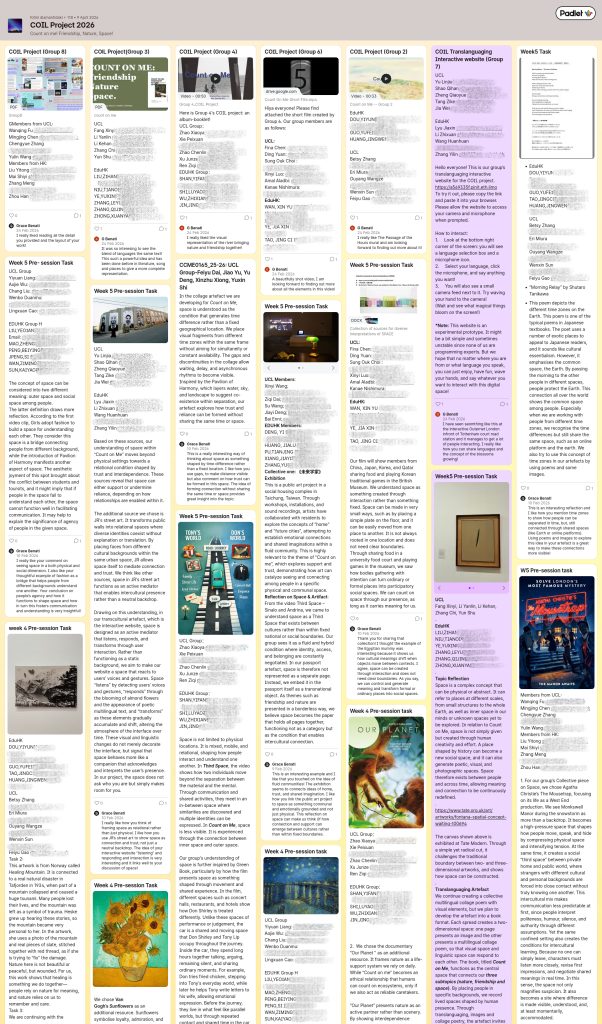
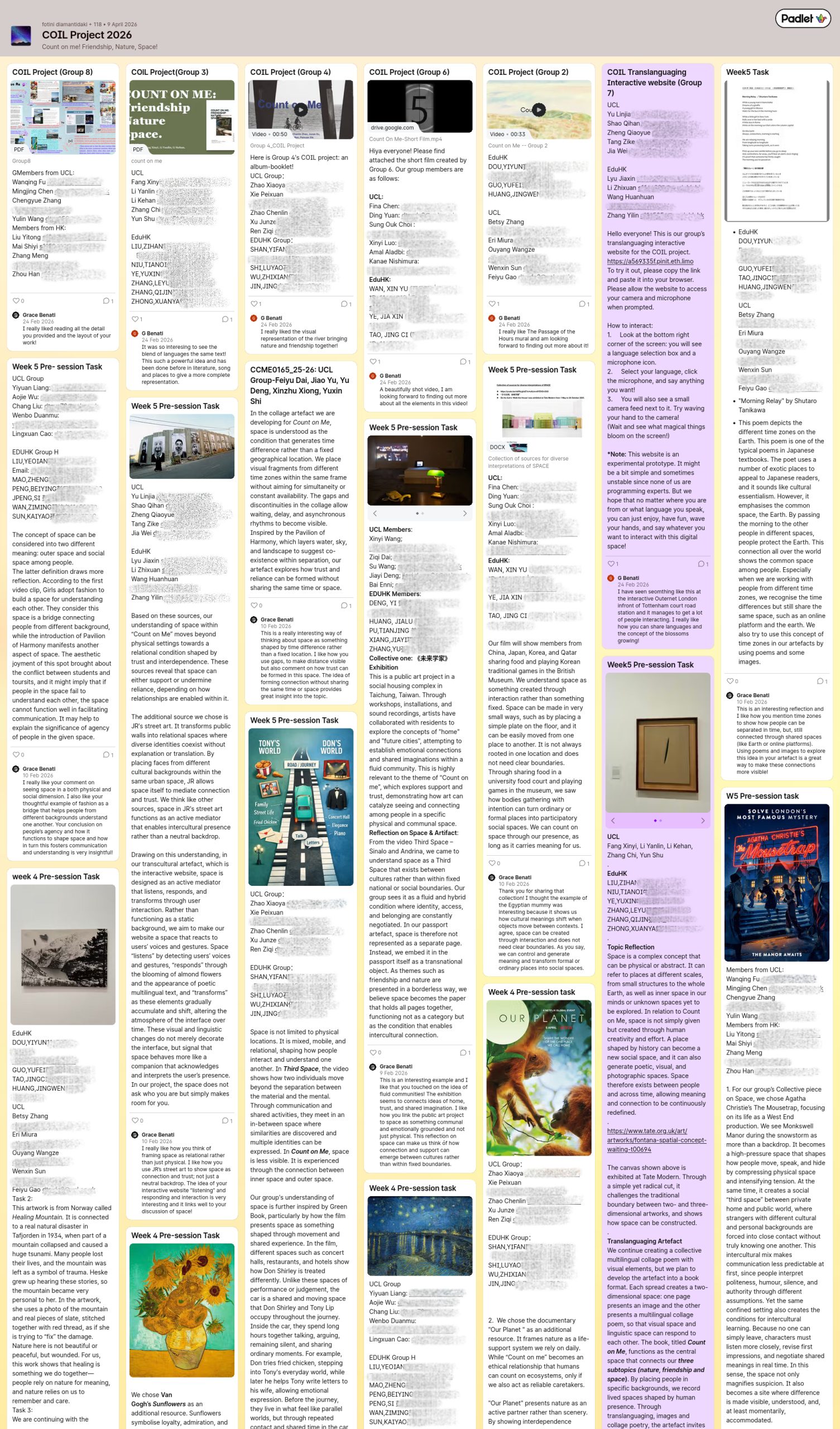
(Padlet as learning management system)
The COIL project has been accepted for presentation at the following conferences:
Diamantidaki, F., Lam, S. M., Troi, E., & Woo, J. (2026, July 9–13). Artefacts in motion: Intercultural learning and translanguaging through collaborative online international learning (COIL). Paper presented at The European Conference on Arts & Humanities (ECAH2026), SOAS University of London & University College London (UCL), United Kingdom & Online.
Diamantidaki, F., Troi, E., Woo, J. & Lam, S. M. (2026). Transcultural online collaboration and translanguaging creativity: A multisite COIL project on intercultural understanding in school and university contexts, International Conference on Foreign/Second Language Acquisition (ICFSLA), Poland, 28-30 May.