

Dr. Timothy Taylor
GEK2020 Positive Communication in
Educational Settings
Positive Communication in Educational Settings (GEK2020) is a 3-credit interdisciplinary course normally taken in year 2 or 3 as an elective in the PAVE stream of GE courses. Co-taught by instructors from the Departments of English Language Education, Psychology, and Special Education and Counselling, the course explores the theory and practice of positive communication in contemporary educational contexts. Drawing from perspectives in language, pedagogy, psychology, and sociology, it examines how positive verbal and non-verbal communication can transform learners’ views of self and community, foster supportive school cultures, and enhance interactions across diverse student populations. The topic of “Teacher Self-Disclosure” (TSD) is introduced as part of the communications and pedagogy aspect of the course, showing students how teachers can introduce their own subjective and phenomenological perspective to make the content of their teaching more accessible to students.
Guest Lecture on Teacher Self-Disclosure
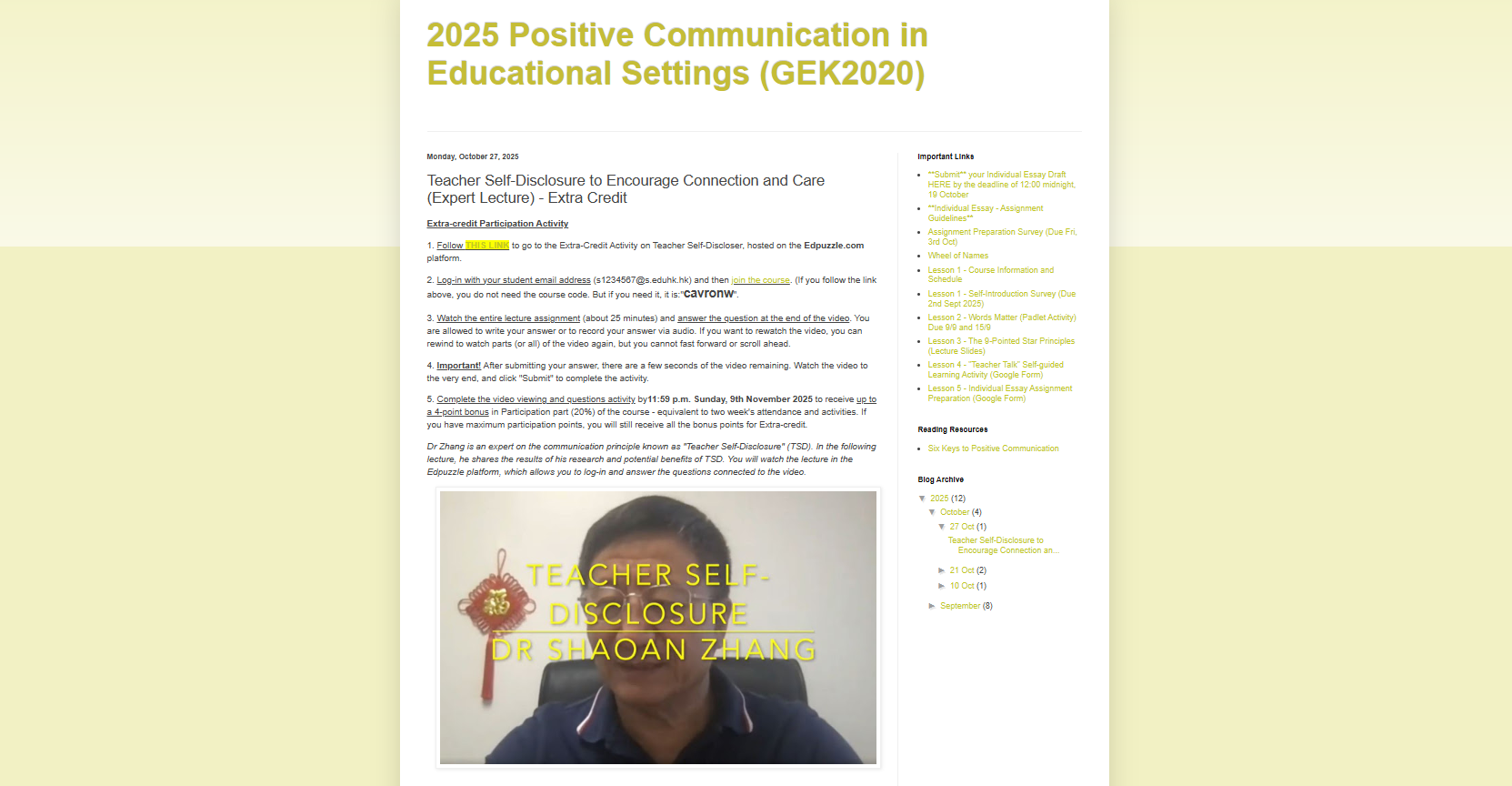
As part of a pre-COIL (Collaborative Online International Learning) initiative to foster strong international partnerships and prepare for future cross-cultural exchanges, students enrolled in the “Positive Communication in Educational Settings” course were offered an optional, in-depth exploration of the topic “Teacher Self-Disclosure” (TSD). Of the 43 students in the class, 26 chose to participate, and 21 successfully completed the activity. Participants accessed a specialized one-hour lecture delivered by Professor Shaoan Zhang, a leading international scholar in teacher education and an established expert on teacher self-disclosure from the University of Nevada, Las Vegas. Hosted on the Edpuzzle platform for flexible, interactive viewing, the lecture provided students with advanced insights into TSD from a globally recognized perspective. Following the lecture, students completed guided reflection questions, designed to take only 10–20 minutes, to articulate their key takeaways and critical reflections on the material. Responses were evaluated on a 0–4 scale (with scores among completers ranging from 1 to 4), and corresponding extra credit participation points were awarded to incentivize thoughtful engagement. This activity served multiple pedagogical goals: it enabled interested students to delve more deeply into a core course theme; introduced an expert, U.S.-based viewpoint to broaden cultural and scholarly horizons; encouraged structured reflection that could facilitate intercultural awareness and dialogue; and established a foundational shared knowledge base for subsequent COIL activities, including planned peer-to-peer discussions between students in Hong Kong and the United States.
 Google Blogger Activity:
 Edpuzzle Activity:
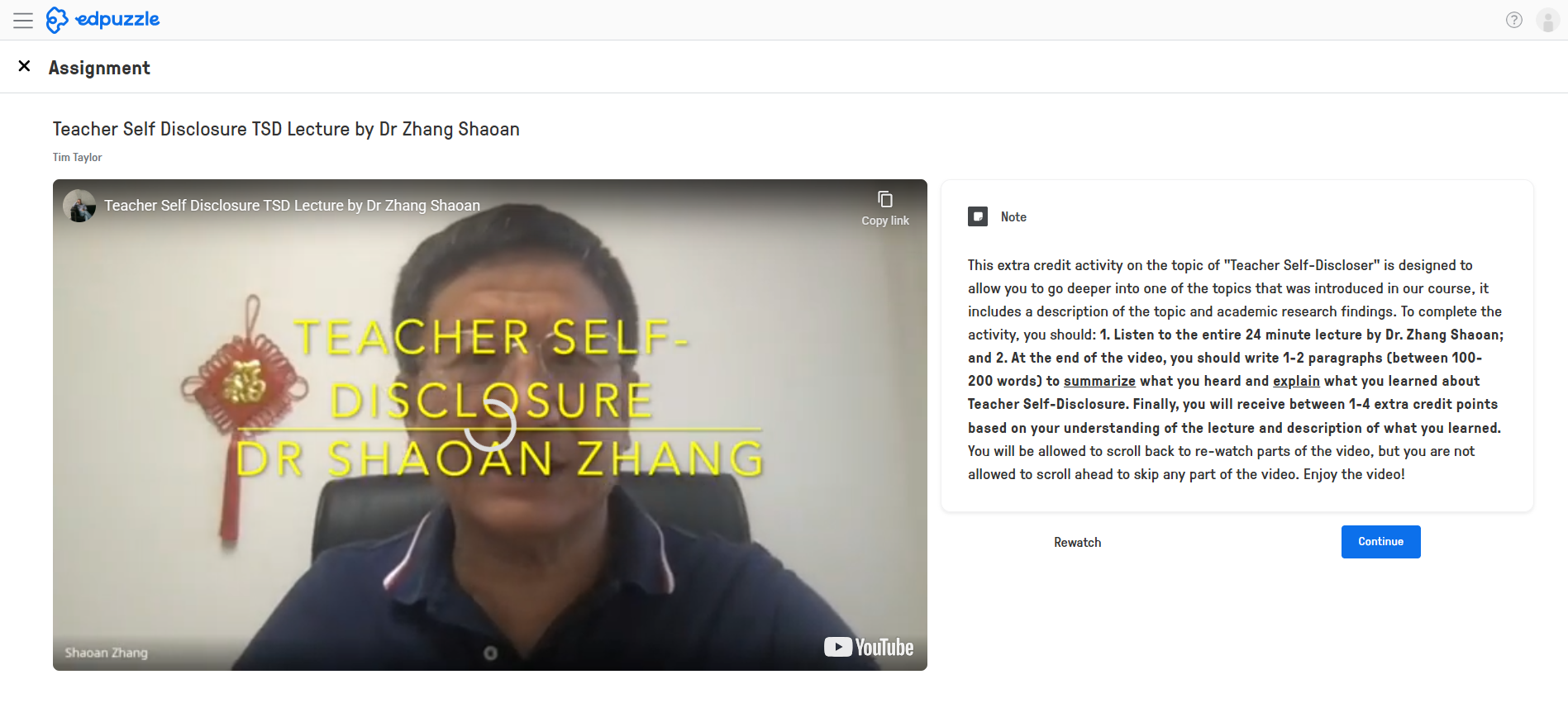
(open-ended question)
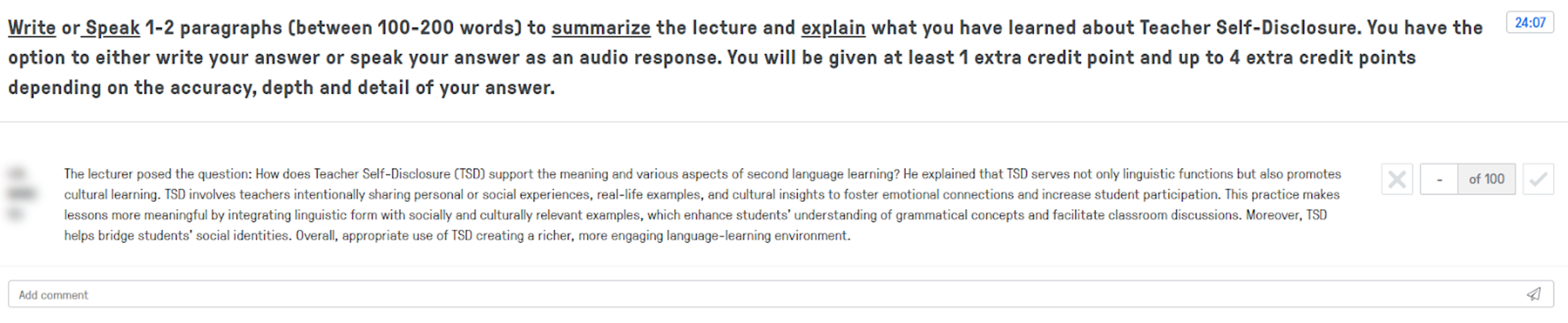
(sample student answer)
Reflection and Evaluation
Student A’s comments:
In this activity, I learned about teacher self-disclosure (TSD) and how it can be used to support students’ language learning in different ways. TSD means when teachers share their personal experiences, thoughts, or feelings with students to make lessons more meaningful. The lecturer explained that using TSD in an English classroom can help students improve academic, social, and cultural skills. For example, when teachers share their own stories while teaching vocabulary, it can make new words easier to understand and remember. TSD can also highlight cultural relevance by connecting language learning with students’ identities and real-life situations. Moreover, it helps build stronger relationships between teachers and students, creating a more open and supportive classroom atmosphere. Overall, I learned that appropriate use of TSD can make English lessons more engaging, relatable, and effective for language learners.
Student B’s comments:
I consider the TSD activity quite helpful for L2 teaching. It allows teachers to be a curriculum maker instead of a follower. Students could benefit a lot from TSD, which includes making the teacher’s talk or teaching content include more in relation to personal situations and cultural insights. On one hand, it can facilitate cross-cultural discussions, if a teacher shares personal views related to cultural contexts. On the other hand, students could engage in L2 learning deeply when teacher provides individual preferences, as it connects social language with academic learning.
Student C’s comments:
From this video, I understand that the experience of Dr. Shan and Dr. Tim in China have brought them the skills of engaging with the students learning with a variety of innovative pedigogies. As a future teacher, i think the experience, opinions, and cultural insights could affect how students seems us as a good or bad teacher. So, self disclosure of teachers plays a important role in the classroom teaching is what I understand. It provides a relatable examples that improves the student’s understanding of grammar concepts. Allowing teachers to contextualize language learning within cultural meaning frameworks is also supporting. It helps connecting students and teachers.